
Explained: Player Ratings
This article is from our initial release of the "State of the Chart" magazine, detailing our process for creating a data-driven foundation for our depth charts and the insights that follow.

Hi friends. We released the first version of our State of the Chart™ digital magazine yesterday. It was a monumental day for us. But, it’s also just the beginning. We will be releasing a new version weekly, leading up to the season, along with detailed logs of edits and updates. We are going to stay on top of all the camp news, player movement, risers/fallers, and everything. This is an article from the magazine that I wanted to share here…
At CFBDepth, we are data-driven and data-informed, utilizing all the cool buzzwords that make us feel high-tech. But, we do mean it. Our player ratings are a combination of multiple data sources, consolidated into one place, weighted and normalized to a scale of 0-20. So, where do they come from, and how exactly are they applied to the insights that come from them? That's a fair question, and one that's important for you to understand before diving fully into the daunting pages that follow.
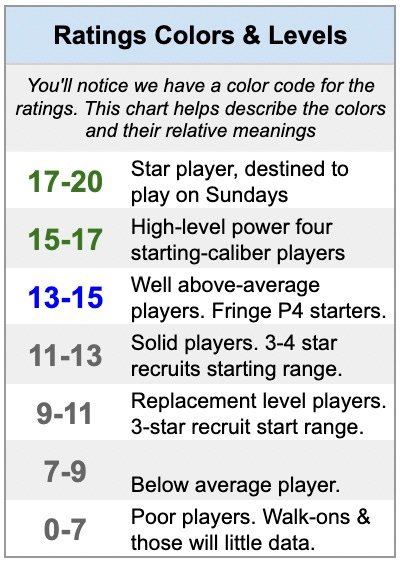
We are unapologetic in stating that we utilize all available data and bring it together to inform our player ratings. We leverage Pro Football Focus' (PFF) player-level data, 247Sports/On3 recruiting data, advanced metrics from other sources, and competition-weighted baseline statistics. While we can't divulge our 'secret sauce' or the algorithm we run this data through to generate our ever-evolving player ratings, we can give you a glimpse into the basics. If nothing else, the purpose of this article is to ground you in the fact that we are driven by the data we ingest from these excellent sources of information.
We start with the composite recruiting data (if available). For those without a data point, we utilize situational factors to assign a starting point, but it remains below the lowest level player rating from the composite.
As the player begins to accrue playing time and we collect player-level data, it starts to overtake the recruiting data. Once a player reaches a baseline volume (unique to each position), the recruiting data no longer has a factor.
These are the primary steps taken in the evolution of our dynamic player ratings. Other factors come into play that you should know about:
Recency Weights
Recent performance is the most significant determinant of a player's ability. However, past performance shouldn't be ignored. As the great Ron Schandler (Baseball HQ) says, "Once you display a skill, you own it." We don't discard past performances, but weigh the most recent ones the heaviest.
Competition Factor
We apply a small competition level factor to the numbers and data points. These take into account playing in the SEC/Big Ten, other Power Four schools, Group of Five level, FCS level, and below (D2/D3, JUCO, or NAIA). Depending on the level of competition faced, the factor comes into play for each of their metrics.
Social and Relative Factors
We want to ensure that we are inclusive in our approach to building the cornerstone of everything we do. We also apply "social" and "relative" factors in some instances…
Keep reading! You can get the full-on 863-page State of the Chart™ digital magazine today (July 22nd) for 50% off at just $9.99.
Keep reading with a 7-day free trial
Subscribe to CFBDepth’s Substack to keep reading this post and get 7 days of free access to the full post archives.