
The Ripple Effect: Mike Gundy
Jack Walsh returns, continuing a series of articles examining each of the 16 head coach firings, the fallout, the path forward, and the ripple effect on other coaching positions.

Jack Walsh was born and raised in Eugene, Oregon, and grew up near the University of Oregon. He seized the opportunity to attend and graduate from the institution that helped raise him. He is passionate about using data to understand the great game of college football at the institutional and structural levels. Not just his favorite teams (you can guess it), but yours as well.
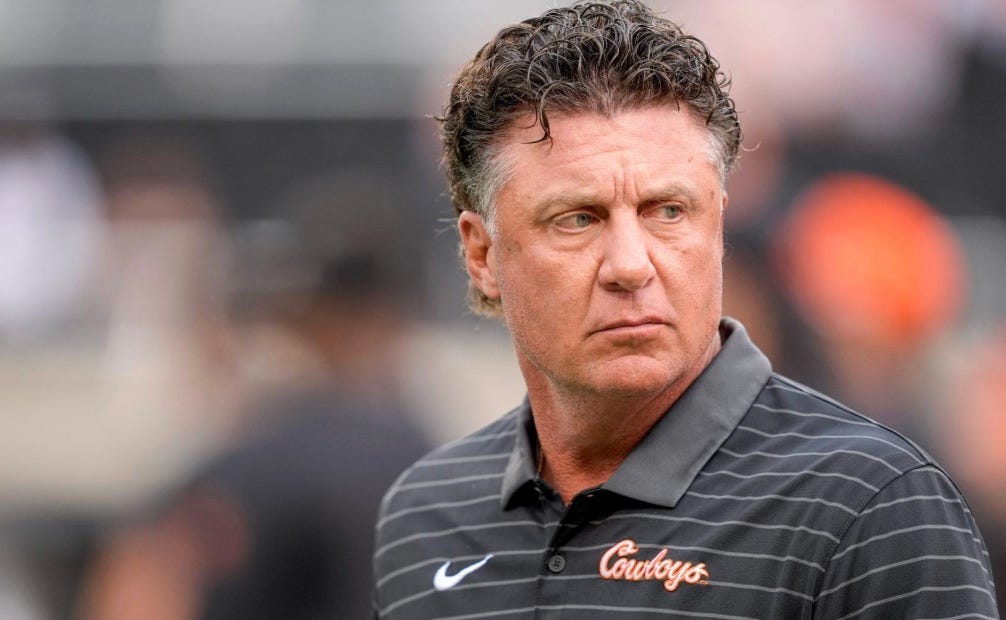
Mike Gundy has come a long way since his infamous “I’m a man, I’m 40” presser. For twenty seasons, Gundy was Oklahoma State football. You would think that his firing would be a day of mourning; instead, the feeling was one more of relief. He was the longest-tenured head coach to be given the pink slip this season, and thus his impact was far greater than that of his peers.
Before Gundy took over in 2005, Oklahoma State was historically inconsistent and largely irrelevant on the national stage. The Cowboys had managed just one 10-win season in program history prior to his arrival and spent much of the 1980s and 1990s cycling through losing campaigns and transitional rebuilds. Bowl appearances were sporadic rather than expected, and any momentum the program built tended to be short-lived.
Perhaps most importantly, Oklahoma State operated in the shadow of the Oklahoma Sooners football program. Bedlam was more ritual than rivalry, and the Cowboys were typically playing for respectability rather than conference positioning. Even during the more competitive stretches under Les Miles, the program felt opportunistic rather than structurally sound, often cracking the top-20 but failing to finish there.
Gundy changed that baseline.
He normalized bowl appearances and made eight- and nine-win seasons feel routine. The 2011 campaign was a prime example of the growth Gundy had driven: a 12–1 season capped by a Big 12 championship and a Fiesta Bowl victory. He permanently altered the perception of what Oklahoma State could be. Throughout the 2010s, the Cowboys were not merely competitive; they were consistently relevant, producing NFL quarterbacks such as Brandon Weeden and Mason Rudolph and contending in the upper tier of the conference.
How it went down
After a 12–2 season and a Big 12 Championship Game appearance in 2021, things were looking up for the Pokes, but the hope never translated to success.
Over the next three seasons, Stillwater experienced the lowest of lows. The win total declined, but more importantly, its efficiency profile eroded. The Cowboys fell from a top-20 SP+ caliber team in 2021 to hovering around the national average by 2024. Offensive explosiveness — long a program staple — dipped significantly, and defensive efficiency went down with it.
In 2023, they finished outside the top half of the conference in yards per play allowed, and by 2024, the unit ranked near the bottom of the league in defensive success rate. The Cowboys surrendered over 30 points per game in consecutive seasons: A stark contrast to the 2021 team that allowed just 20.6 points per game and ranked top-10 nationally in total defense.
Offensively, the identity blurred. Oklahoma State had long been star-driven and explosive, but in the final two seasons under Mike Gundy, the Cowboys ranked outside the top 40 nationally in yards per play and struggled in high-leverage downs, finishing near the bottom of the Big 12 in third-down conversion rate. It was a shell of its former self.
Recruiting and roster retention compounded the issue. Oklahoma State’s high school recruiting classes slipped toward the bottom third of the Big 12 rankings, and portal churn increased (negatively) in the NIL era. While the Cowboys still developed talent, the depth advantage that once separated them from the conference middle narrowed considerably.
With Texas and Oklahoma leaving for the SEC, 2024 represented an opportunity to plant their flag as a fixture in the reshaped Big 12. It was one of its most stable brands and most experienced programs. Instead of consolidating power, the Cowboys finished last in the league and were winless in conference play.
Zero conference wins over his final two seasons, declining defensive metrics, middling offensive efficiency, and poor roster construction that no longer separated OSU from its peers created a data-backed case that Gundy couldn’t cut it in the modern CFB landscape.
Three weeks before his firing, Gundy cried out for help from the donor base and the athletic department. He argued that he shouldn’t be expected to compete against teams with $20M+ budgets. For an administration staring at a wide-open conference hierarchy, Gundy’s team wasn’t even sniffing the baseline of competitiveness and the plug was pulled on September 23, 2025.

A quick plug for the “The Year That Was: 2025-26” magazine that we are actively working on. This is a data-driven, almanac-style publication to relive the year on and off the field. It’s a must-have for true college football fans. Release: Mid-April.
The Interim(s) Impact
After Gundy was dismissed, Doug Meacham stepped in, bringing a career closely linked to some of the most explosive offenses in the Big 12 over the past decade. Meacham first gained national attention during his time with TCU Horned Frogs football, where he served as co–offensive coordinator from 2014 to 2016 under Gary Patterson. Those TCU teams quickly became some of the most dangerous offenses in the country. In 2014, the Horned Frogs averaged 46.5 points per game, ranking among the top five nationally in scoring offense, fueled by a Heisman-caliber season from quarterback Trevone Boykin, and finished 12–1 with a Peach Bowl victory.
His brief tenure as the Cowboys’ head man was a stark contrast to his time at TCU, as he failed to win a single game (0-9) and appeared uncompetitive against most opponents. Nobody expected Meacham to accomplish much, so in that regard, he met expectations. He was quickly replaced by North Texas head coach Eric Morris at the end of the season and the 2025 season was swept under the rug.
The Transition to Eric Morris
The aftermath was immediate and dramatic. The combination of an 18-game conference losing streak, the dismissal of the winningest coach in school history, and a relatively young roster navigating the modern NIL landscape created the perfect conditions for a mass roster exodus. Only two offensive skill players from 2025 remain on the roster for 2026: QB Noah Walters [10.8] and TE Oscar Hammond [11.3].
Within a month of the coaching change, roughly half of Oklahoma State’s scholarship roster entered the transfer portal. In another era of Cowboys football, that level of turnover might have been catastrophic. Given the direction of the program at the end of Gundy’s tenure, that level of transformation appeared both necessary and inevitable.
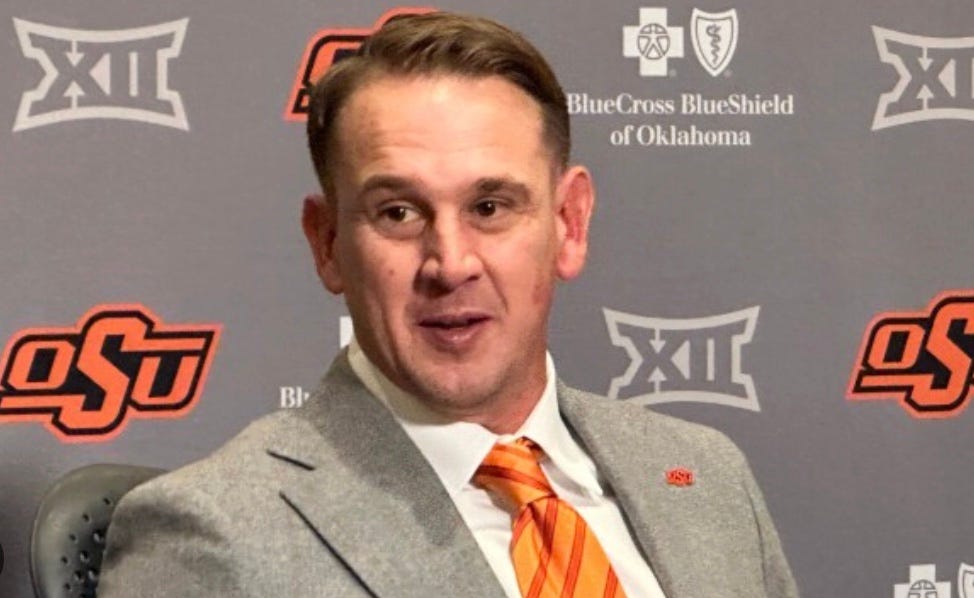
Sure, they lost a lot. But in hiring Morris, they also knew they would get an influx of talent immediately — including top offensive weapons from North Texas: QB Drew Mestemaker [16.8], RB Caleb Hawkins [17.6] and WR Wyatt Young [16.3]. These are the foundational pieces of a new “Air Raid” offense coming in and bringing back the electricity to Stillwater. Overall, here is a look at the ‘portal churn’ for the off-season, ranked squarely in the middle of the pack:

The Ripple Effect
Any major head coaching firing or dismissal is a trigger event that can lead to a wide-ranging ripple effect. Let’s take a look at how this firing and eventual new hire impacted other jobs around college football:
Mike Gundy and Doug Meacham have yet to find new homes in CFB, thus the ripple effect has been relatively contained. Combine that with the fact that North Texas ended up replacing Eric Morris with a previously unemployed Neal Brown, and you get a clean, closed loop.
Mike Gundy dismissed at Oklahoma State »»» Doug Meacham takes over as interim head coach »»» Oklahoma State hires Eric Morris from North Texas as head coach »»» North Texas hires Neal Brown as head coach.
The New Staff
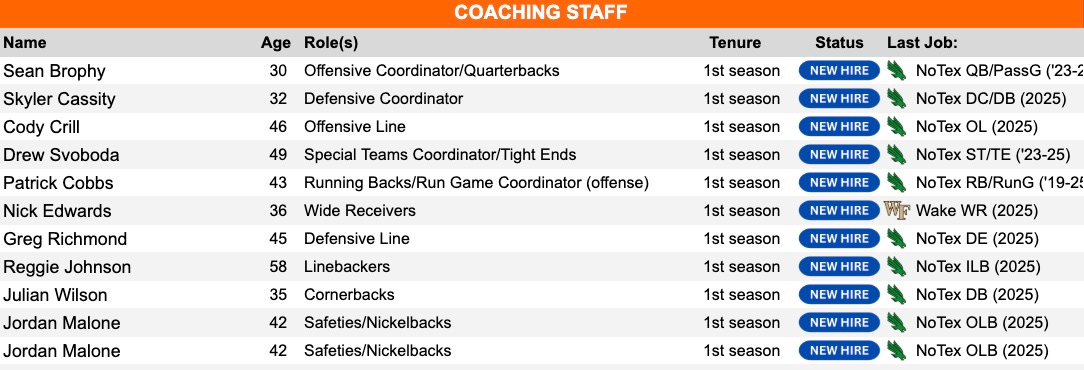
Eric Morris brought nearly his entire staff over from UNT, many of whom he’s worked with at prior stops as well. Nick Edwards (Wide Receivers) represents the only non-former UNT assistant, and at this point you might as well call them the Oklahoma State Mean Green.
Will it Work?
Eric Morris brings a youthful energy that had begun to fade in the final years of the Mike Gundy era at Oklahoma State Cowboys football. In the modern era of college football, younger coaches have increasingly found success not just because they relate more naturally to their players, but because they are less tied to the structural habits that defined the sport before the transfer portal and NIL reshaped roster management.
The NIL era demands speed and alignment. Coaches must build buy-in quickly while understanding that players now face legitimate business decisions about where to play and how to develop their careers. Morris appears comfortable operating in that reality.
His move to Stillwater immediately demonstrated that approach. Rather than beginning from scratch, Morris brought a number of players he had already recruited and developed with him, creating an unusual level of continuity during what could have been a chaotic start to his tenure. In a program that had just lost the winningest coach in its history and seen a large portion of its roster enter the transfer portal, that kind of built-in familiarity offers a rare proof of concept.
Rebuilds in the modern Big 12 rarely take long to show progress, but the conference is crowded with programs that have established identities and veteran coaching staffs. Morris’ challenge will be turning early cultural momentum into on-field consistency quickly enough to stabilize the program. The early signs suggest Oklahoma State understands the direction it wants to go, the next step is proving it can get there and the star players on offense following Morris from North Texas must show they belong at this level. If that happens in 2026 — yes, this will work quite well.
 | A guest post by
|