
The Ripple Effect: Sam Pittman
Jack Walsh continues his breakdown of the fired coaches and what comes next for each program during this off-season series: The Ripple Effect.

Arkansas’ Firing of Sam Pittman: When a Head Coach Hits the Ceiling Too Early
Sam Pittman was not hired to win the SEC. He was hired to make Arkansas football functional again.
When the Razorbacks turned to him ahead of the 2020 season, the program was coming off consecutive 2–10 campaigns. Recruiting relationships were fractured, player development had stalled, and SEC competitiveness felt distant. Arkansas did not need a schematic innovator, but rather just some structural credibility.
Pittman delivered that quickly.
By 2021, Arkansas was 9–4 and was physically competitive with the upper tier of the SEC West. The Razorbacks averaged 30.9 points per game and allowed just 22.9. SP+ and FPI both confirmed their rankings within that coveted Top 25 nationally. The rebuild had been realized quickly, and this hire looked like a genius move.
Fast forward to halftime of a late September game in 2025 against Notre Dame, with the Razorbacks trailing 42-13, and you’ll find an almost sure ending to this nuanced tenure in Fayetteville. What makes his eventual dismissal following that game so intriguing is that Pittman did the job he was hired to do. The job and the expectation therein evolved.
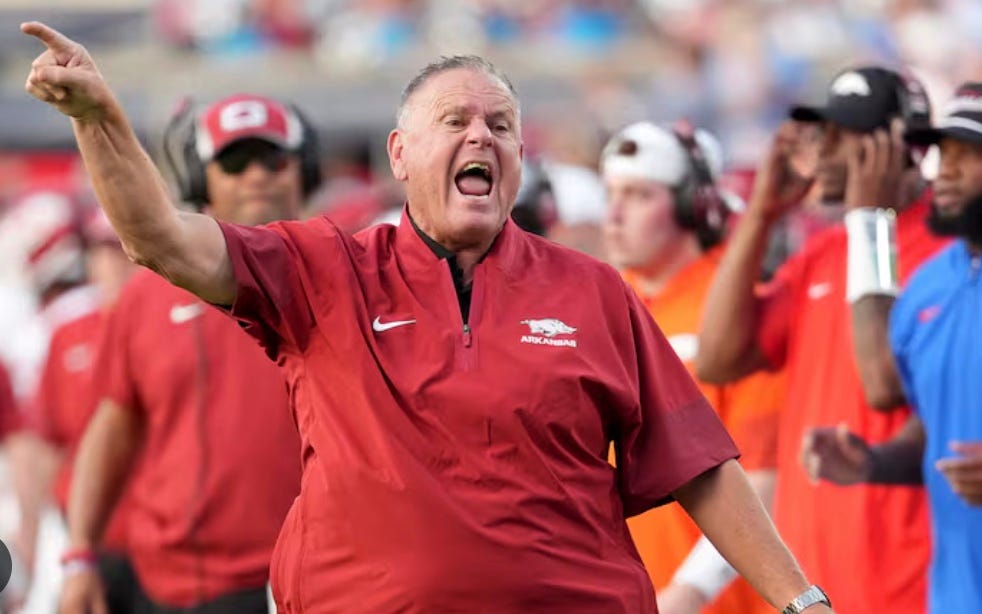
After 2021, the trajectory flattened. From 2022 through 2025, Arkansas went 22–28 overall and 9–23 in SEC play. The Razorbacks avoided the valleys of the Chad Morris era, but they never returned to the competitiveness of 2021. Recruiting classes remained inside the top 35 nationally — sufficient for bowl eligibility, insufficient for actual disruption and/or growth towards the upper-tier of the conference.
Then came the hard reality.
By early 2025, Arkansas had fallen back to 2–3 when the axe came down. They played out the string with a former head coach in Bobby Petrino (talk about some nuance) and finished 2-10, the same record that triggered the previous reset. The program has regressed to the pre-Pittman floor, and they now seek the new Sam Pittman. To do this job — but sustain the gains.
How It Went Down
The inflection was not emotional, and it was not tied to a single Saturday. It was reflected in the underlying metrics that had been trending downward since that 2021 peak.
Defensive performance deteriorated steadily after that season. Points allowed rose from 22.9 per game in 2021 to 30.6 in 2022 and hovered near the 30-mark across the following years. Explosive plays were allowed more often, third-down conversion rates worsened, and conference scoring margins turned consistently negative. SP+ dropped from 22nd nationally into the mid-40s and 50s range by 2023, while FPI projections increasingly slotted Arkansas into the lower half of the SEC hierarchy.
The offense never completely collapsed, but it could no longer fully compensate or keep pace with the ineptitude on the other side. Rushing production declined from 5.3 yards per carry in 2021 to below 4.5 in multiple subsequent seasons, and the offensive line stopped functioning as a structural advantage against upper-tier fronts. Close games that once broke Arkansas’ way began to swing in the opposite direction, reinforcing the sense that the program was no longer climbing.
By 2023, administrative evaluation shifted from appreciation to projection. The question was no longer whether Pittman had repaired the program, but whether this structure could produce something beyond middle-tier SEC positioning. The first five games of the 2025 season was enough to confirm that the program stalled — and stalling you can not do in the SEC.
Petrino’s Impact
Bobby Petrino’s interim tenure functioned less as a long-term audition and more as a stabilizing bridge during administrative transition. His experience and familiarity with the infrastructure reduced in-season friction, given his prior experience as the program’s head coach.
Petrino proved very quickly that he was not the man to take over the team long-term, and given the way he handled his original tenure from 2008-2011, the fanbase was grateful for that, unless they just have a sick sense of humor and have no problem with the program becoming a most popular meme. They didn’t even maintain baseline competitiveness, but at the very least, his tenure bought the administration time to execute a deliberate search without compounding instability. They played a lot of close games down the stretch after the Pittman firing — they just lost them all.
Roster Impacts
The roster did experience significant portal movement, but the optics were more dramatic than the structural damage. Arkansas saw a wave of departures following Pittman’s dismissal, yet the majority of exits were rated as rotational pieces, depth contributors, or players buried on the two-deep. Very few quality SEC-caliber starters left the program. That distinction matters.
This was a trimming of the margins. The core of the roster remains partially intact, but that wasn’t going to mean much for the success of this season. Rather than a full teardown seen at other programs like Oklahoma State and Penn State, the transition was more of a redirection, clearing many redundant pieces while leaving space for immediate stabilization under the next regime.
The Ripple Effect
Much like DeShaun Foster’s dismissal at UCLA, Sam Pittman’s firing did not generate a sweeping ripple across the national coaching carousel. The impact remained relatively contained, in part because Pittman himself has yet to resurface in a major role, limiting secondary movement across Power Conference staffs.
Sam Pittman dismissed as head coach at Arkansas »»» Bobby Petrino takes over as interim »»» Arkansas hires Ryan Silverfield from Memphis »»» Memphis hires Charles Huff away from Southern Miss »»» Southern Miss promotes Blake Anderson to head coach.
The Silver(field) Lining
Another signal of direction is the composition of the 2026 staff. The Razorbacks have hired Ryan Silverfield to get the program back on track — and keep it there.
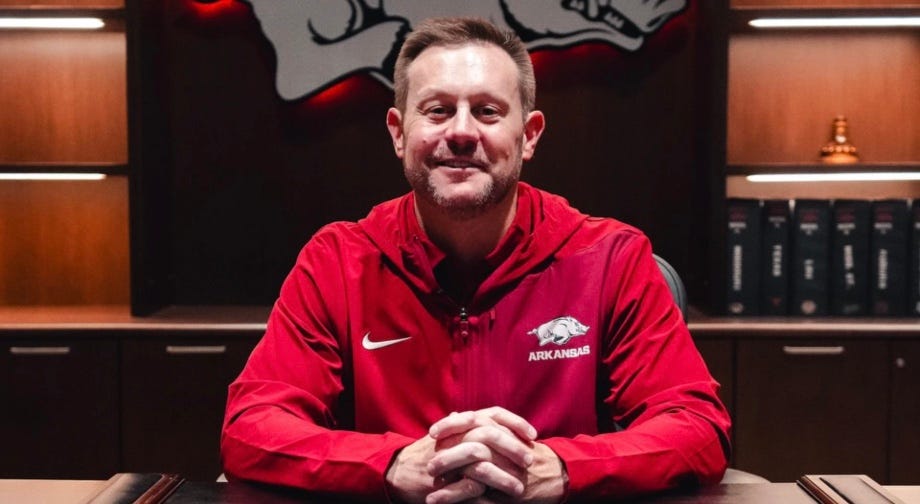
When building his first staff here, he leaned into experience on offense, importing familiarity where production already existed.
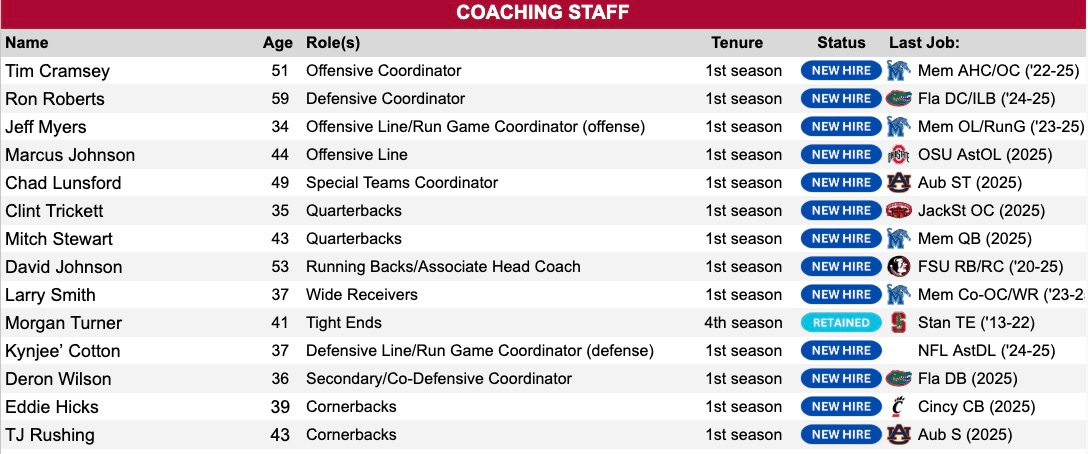
He brings Tim Cramsey in as offensive coordinator after four seasons in the same role at Memphis. Cramsey’s units averaged 36 points per game during that span. At wide receiver, Larry Smith comes from Memphis, giving Arkansas immediate continuity in the passing game. David Johnson takes over running backs after coaching the position at Florida State, adding Power Conference recruiting experience to the staff.
The offensive line room is split between outside pedigree and internal familiarity. Marcus Johnson arrives from Ohio State, where he served as an assistant offensive line coach, while Jeff Myers follows Silverfield from Memphis to maintain continuity in run-game installation. Clint Trickett will coach quarterbacks after serving as offensive coordinator and quarterbacks coach at Jacksonville State, bringing play-calling experience to the position room.
Defensively, Ron Roberts anchors the staff as defensive coordinator, having served in that role at Florida and Auburn in recent years. His background includes multiple SEC stops and prior coordinating experience across Power Conference programs. CJ Wilford joins from Georgia State, where he coached safeties, and Marion Hobby arrives from Tennessee, where he served as a defensive analyst after previous NFL and collegiate defensive line coaching roles.
The structure is deliberate. Silverfield paired familiarity with Power Conference exposure and experience, reinforced the offensive system with overlapping staff ties, and anchored the defense with an established leader. It is not a wholesale rebuild. It is a staff built to shorten the transition time.
Here is a look at the full on-field 2026 coaching staff as it stands:
Will it Work?
Projecting Silverfield’s floor and ceiling at Arkansas requires separating emotion from structure. A portion of the fan base has framed the hire as another botched move in a cycle that has produced uneven results, and skepticism is understandable given the program’s recent volatility. Silverfield did defeat Arkansas head-to-head during just this past season, but that result alone does not define scalability in the SEC.
More instructive are the early structural indicators. Portal additions have been targeted, with Arkansas sitting at #11 in our Portal Churn rankings.
Silverfield also arrives with a track record of offensive production, averaging 36 points per game at Memphis. The question is not whether he can generate offense. It is whether that production translates against SEC defensive fronts and whether defensive efficiency improves under the new staff. What adjustments are necessary to the scheme and direction that he and his trusted offensive partner Cramsey need to make to see this through and avoid stalling?
There is reason for cautious optimism. Whether that optimism materializes into competitive separation will depend on how Silverfield handles the next few years from a player-personnel perspective.
 | A guest post by
|